Five Rules That Keep A Faceless Channel From Being Terminated
Everyone starts with the same question. How do I get views? It is the only question that feels urgent when the channel is new and nothing is happening.
Stay in this long enough and the question quietly changes. It becomes: how do I not lose what I have built?
I have watched people spend months producing content, get something working, and then lose it in a single night over a handful of decisions about sourcing and originality that seemed harmless at the time. That hurts more on a faceless channel aimed at an English-speaking audience, because those channels usually represent more production hours and more invested cost per video than a casual channel does.
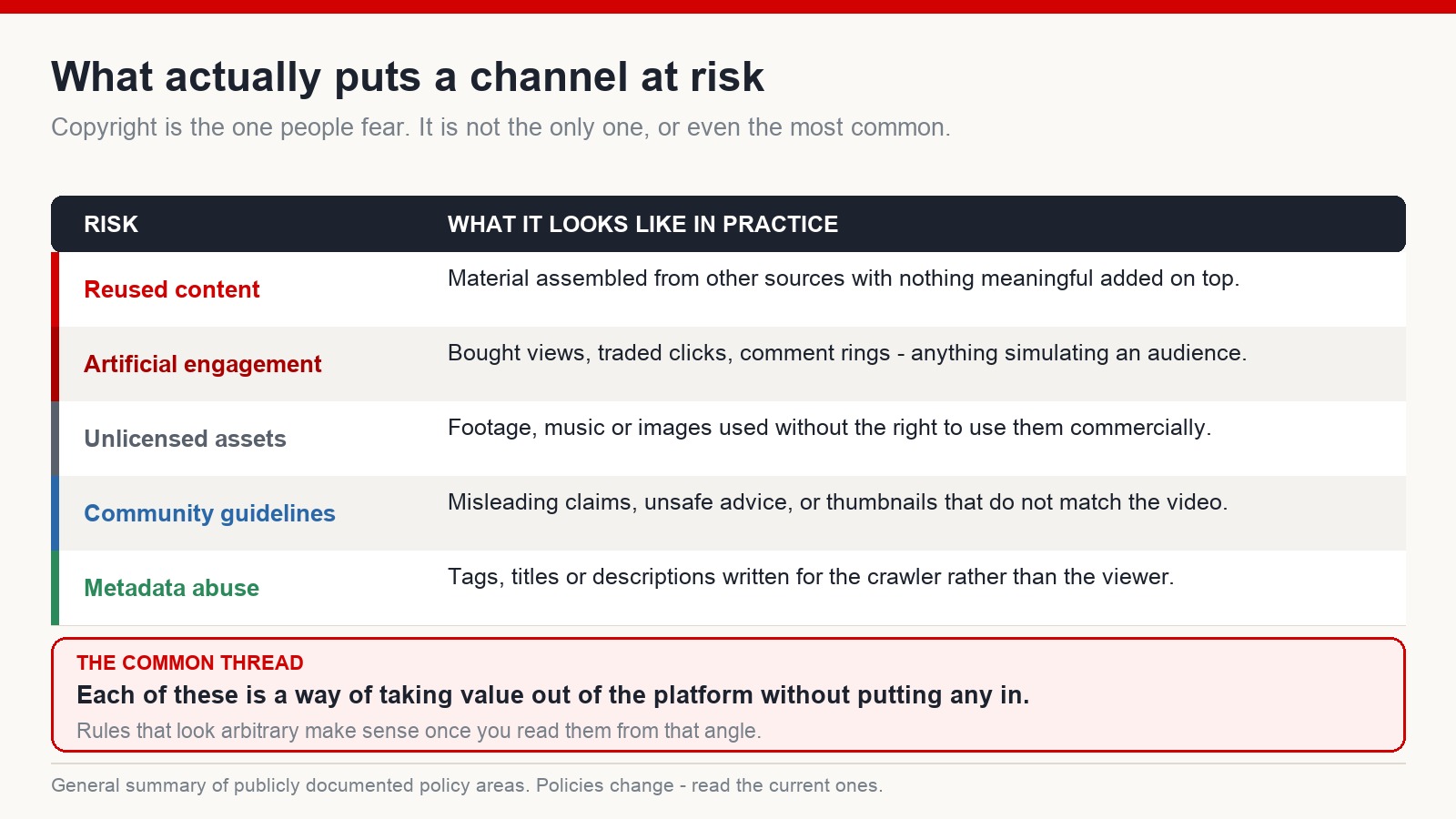
Copyright is not the only way this goes wrong
Most people assume channels get removed over music and footage. That is one route. It is not the most common one.
The list is broader: content assembled from other sources with nothing added on top, artificially inflated engagement, unlicensed assets, community guideline problems like misleading claims or thumbnails that do not match the video, and metadata written for the crawler rather than for a human being.
What connects all of them is worth internalising, because once you see it the rules stop looking arbitrary. Every item on that list is a way of extracting value from the platform without adding any. The policies are downstream of that idea. Read them from that angle and most of them predict themselves.
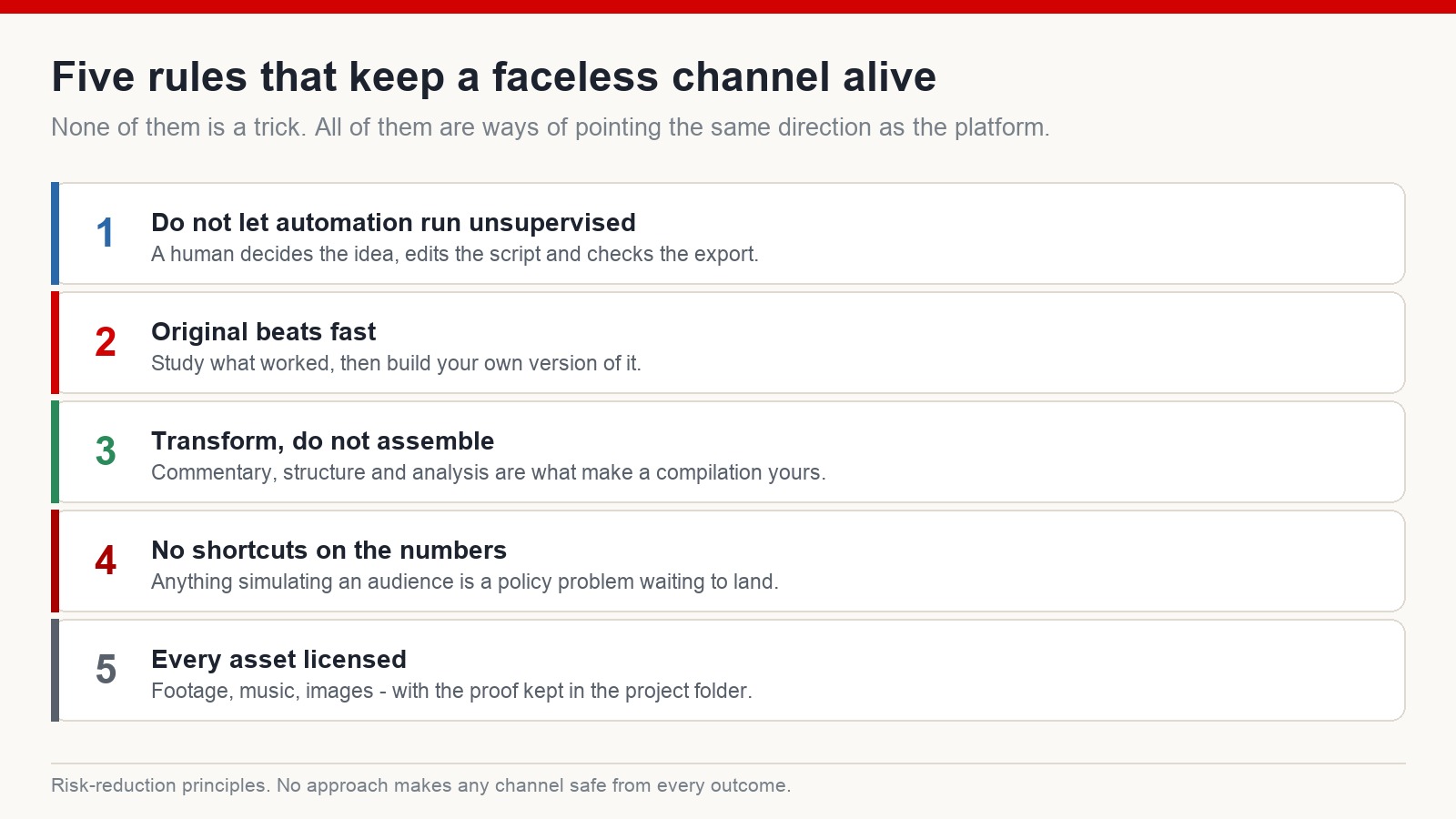
The five rules below are not workarounds. They are ways of pointing in the same direction the platform is already pointing.
Rule 1: Do not let automation run unsupervised
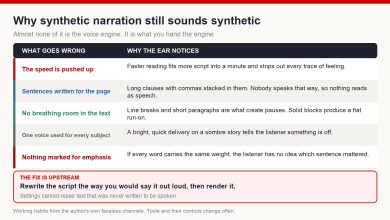
Generation tools have genuinely changed what one person can produce. That is not in dispute. What gets people in trouble is treating the whole pipeline as something that can run without a human in it.
If assets are being assembled automatically with no editorial judgement applied – no script editing, no deliberate structure, nothing that could not have been produced by anyone else running the same prompts – the output starts looking a lot like the reused-content category, whatever tools made it.
A sustainable version keeps a person at four points: the idea is chosen by a human, the script is edited by a human, the narration is directed rather than accepted as-is, and someone actually watches the export before it publishes. That is not slow. It is the difference between a channel and a content mill.
Rule 2: Original beats fast
The tempting shortcut, when you see a video doing enormous numbers, is to take it and republish a version. It is also the fastest route to both a copyright problem and a reused-content flag.
There is a better version of the same instinct. Study what worked – the angle, the structure, the opening, the pacing – and then build your own thing on that foundation. Different examples, your own analysis, your own research, your own voice.
Viewers do not need a copy of something they can already watch. They need a version that gives them something the original did not. That is a higher bar than reuploading, and it is the only bar that produces a channel worth owning.
Rule 3: Transform, do not assemble
Commentary, analysis, documentary and compilation formats can all work. But they only work when something is genuinely added.
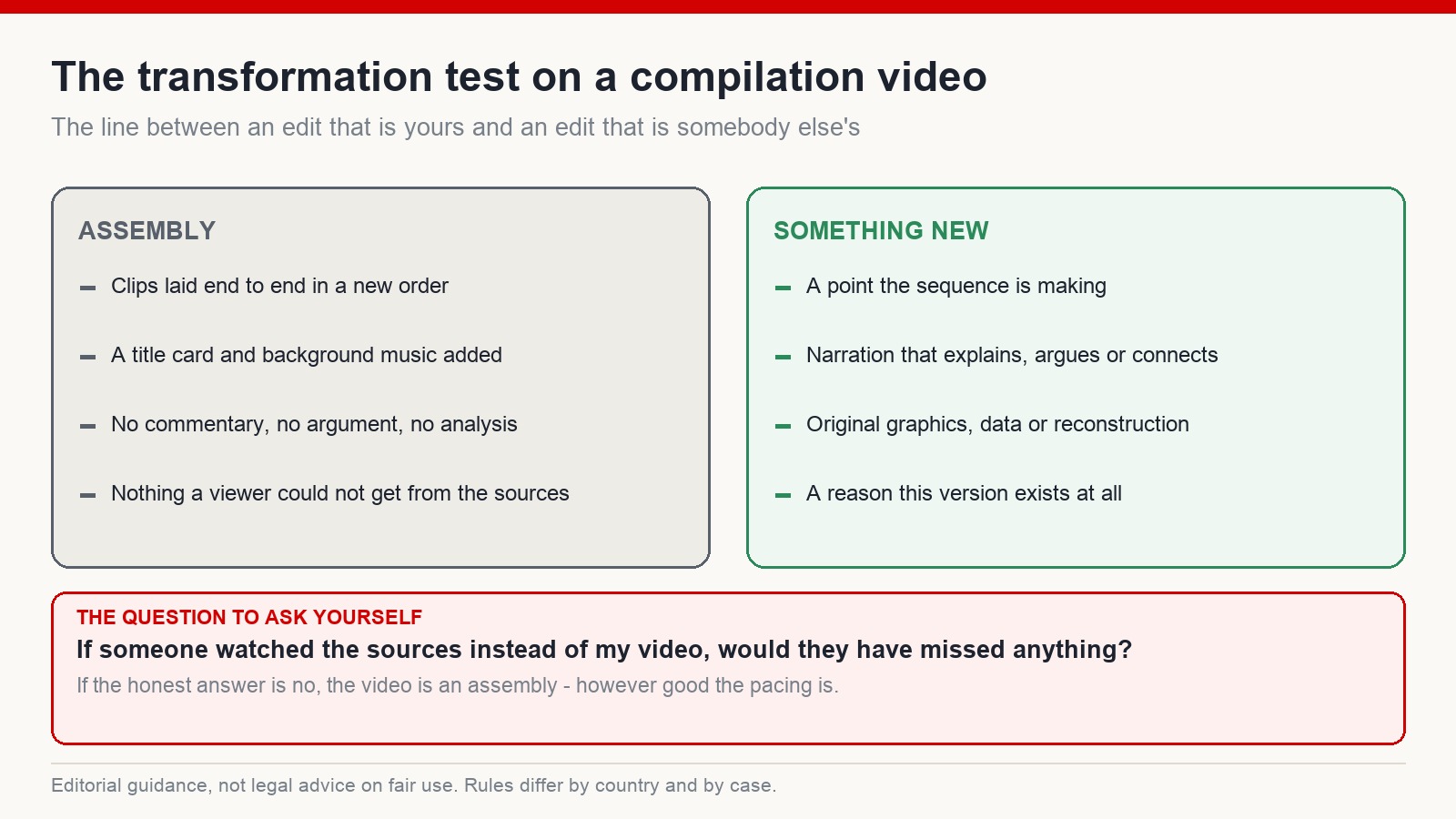
An assembly is clips laid end to end in a new order, with a title card and background music, no commentary, no argument, nothing a viewer could not have got by watching the sources. Something new has a point it is making, narration that explains or connects, original graphics or research, and a reason to exist as its own thing.
There is a single question that settles it honestly. If someone watched the source material instead of my video, would they have missed anything?
If the answer is no, it is an assembly – however good the pacing is, however clean the transitions are. Fair use rules differ by country and by case and I am not a lawyer, but that question is a reasonable editorial test regardless of jurisdiction.
Rule 4: No shortcuts on the numbers
Bought views, traded clicks, comment rings, anything designed to simulate an audience that is not there – these are documented policy violations, and they are worth avoiding for a second reason that has nothing to do with enforcement.
They teach the recommendation system the wrong thing. A viewer who never wanted your video and leaves after ten seconds is the worst possible signal you can generate. You are paying money to tell the system that people do not like your video.
Beyond that, detection improves, and removal can be applied retroactively. The seller keeps the fee either way. The channel is the thing at risk. There is no version of this trade that favours you.
Rule 5: Every asset licensed, with the proof kept
Footage, music, images, fonts, graphics. Own it, license it, or make it.
Prefer material you shot, generated or built. When you use stock, keep the invoice. When a licence requires attribution, follow the exact format it specifies rather than approximating it. Store the licence file in the project folder next to the media, so that proof takes seconds to find rather than an afternoon.
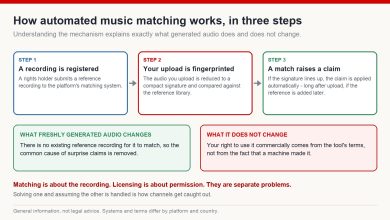
The reason this matters more than it looks: rights claims are frequently retroactive. A track or clip that scanned clean this year can be registered next year, and the matching runs backwards across everything you published. One convenient source reused across a whole library becomes a library-wide problem on a single afternoon.
What tends to survive
Algorithms change. What people want out of a video does not change nearly as fast. The channels I have watched last tend to do at least one of three things reliably: teach the viewer something, entertain them, or leave them wanting to act on something.
If a video does none of the three, its long-term prospects are poor regardless of how well it is optimised.
The failure patterns are just as consistent. Chasing every trend so the channel never establishes what it is about. Republishing other people’s material. Adding nothing on top of source content. Over-automating until nothing distinguishes the output. No editorial direction. Optimising for views while ignoring whether anyone trusts the channel.
Views matter. Trust matters more, because trust is what makes the second video get watched by the people who watched the first.
Frequently asked questions
What puts a channel at risk most often?
Reused content with no added value, unlicensed assets, artificial engagement and community guideline violations. Copyright is the one people fear most, but it is not the most common cause of trouble.
Is it a problem to use generation tools on a faceless channel?
Not in itself. The problem is unsupervised automation – output nobody edited, directed or checked. Keep human judgement at the idea, the script and the final review.
Can compilation content be monetised?
It can, when the material is genuinely transformed: commentary, analysis, original structure or a point being made. A reordering of someone else’s clips with music over it generally is not enough.
What matters most for a channel that lasts?
Value to the viewer, retention, and consistency on a subject long enough that the platform and the audience both learn what the channel is for.
Does following these rules guarantee my channel is safe?
No. Nothing does. Policies change, enforcement is imperfect, and mistakes happen. These reduce risk substantially; they do not eliminate it.
The question worth asking instead
If you are starting from zero, the useful question is not how to get a million views. It is whether this channel will still exist and still be growing three years from now.
Answering that one honestly changes almost every production decision you make – what you source, what you automate, what you are willing to publish. It is a slower road. It is also the one that produces something you actually own.
For a structured route through building an English-language faceless channel from the ground up, mmoyoutube.com covers the full sequence. None of this is legal advice, platform policies change, and outcomes differ enormously between channels.